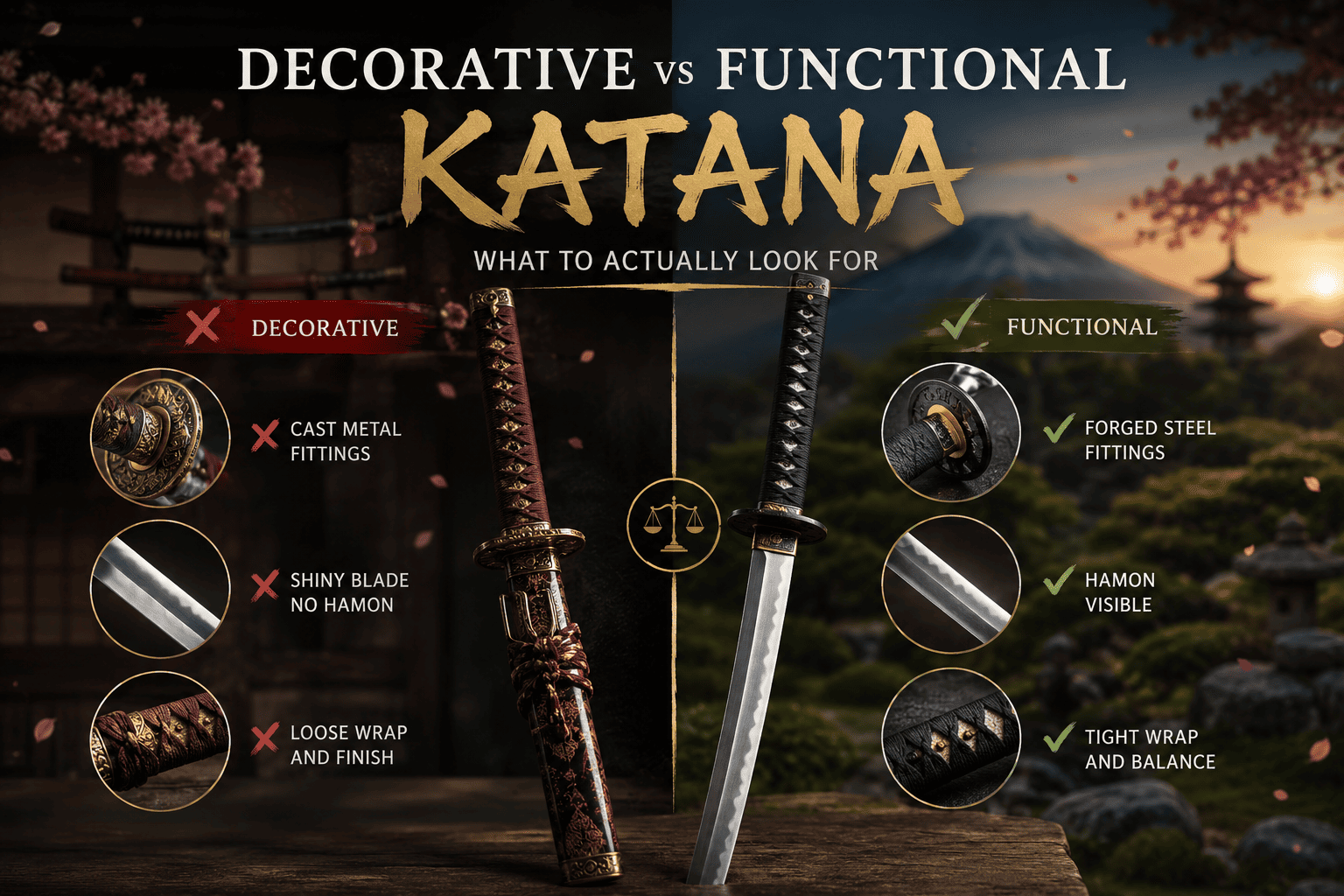
The difference between a display katana and a working one shows up fast when you know where to look. Listings love to lean on beauty shots and big words. Specs tell the real story.
Here is what actually matters, broken down the way you would evaluate any blade.
Why “Looks Sharp” Tells You Almost Nothing
Mirror polish, a visible hamon line, brass fittings. These are the first things that catch your eye in a listing. They are also the last things that tell you if the sword can handle contact.
Decorative swords are built to sit on a stand. The blade might be stainless, the tang might be a welded stub, and the handle might be glued rather than pinned. None of that matters if you never plan to swing it. But the problem is that listings rarely say “this is a wall piece.” They say “hand forged” and “battle ready” and let the photos do the rest.
One easy tell: compare the spec sheets on KatoKatana samurai swords to a random decorative listing. The difference in what gets disclosed is obvious.
What Separates a Functional Build from a Decorative One
The tang is where it starts. A proper nakago runs the full length of the handle and is secured with a bamboo pin called a mekugi. On decorative swords, the tang is often a short rod welded or threaded into the blade. Swing that hard enough and you have a projectile. If the seller will not show the nakago photo, stop there.
Handle construction tells the same story. On a working katana, the tsuka is wrapped tightly over ray skin (samegawa) with a cotton or silk cord (ito). That wrap locks the grip and absorbs vibration. A glued-on faux wrap looks similar in photos but fails the moment your hand sweats.
For buyers comparing options, looking at a few examples of a functional katana helps make the differences easier to spot. Pay attention to whether the listing shows the tang, the pin, and the handle assembly. If those photos are missing, ask why.
Steel, Heat Treatment, and What Buyers Often Misread
You will see steel grades everywhere in katana listings: 1045, 1060, 1095, T10, spring steel. For the 10xx series, those numbers roughly track carbon content, which affects hardness and edge retention. T10 is a tungsten-alloyed tool steel, a different animal. The grade label alone does not make a good blade.
Heat treatment is what makes or breaks the edge. A clay-tempered blade is heated and then quenched with clay applied along the spine, so the edge cools fast (hard) and the spine cools slow (tough). That process creates the hamon line and contributes to the blade’s curve. A through-hardened blade is uniform, simpler, and cheaper. Clay tempered is more forgiving on hard cuts because the soft spine absorbs shock. Through hardened is tougher to break but chips easier at the edge.
Edge geometry matters too. Two blades can use the same steel and same heat treatment but feel completely different in a cut because of how the edge was ground. Thinner edges slice better but chip easier. Thicker edges survive abuse but drag through material.
A 1095 label tells you less than a bad heat treat will. Ask about the process, not just the alloy.
What Knife People Notice When They Pick Up a Katana
If you handle knives regularly, the first thing you will notice is balance. A katana is not just a large knife. The weight sits further forward, and the curve changes how force travels through a cut. That forward balance lets the blade do more work with less effort on draw cuts.
Grip shape is different too. A katana handle is oval, not round, so your hands orient the edge by feel. Think of how a good fixed blade lets you index the edge without looking. Same idea, but the longer handle and two-hand grip change the feedback entirely.
Then there is fit and finish. On a well-built katana, the habaki (blade collar) fits tight, the tsuba sits flush, and there is no rattle. Pick it up, hold it point forward, and tap the spine. A buzz or looseness means the fittings are not seated right.
Common Buying Mistakes
- Buying on price alone. The cheapest functional katana can work. The cheapest decorative katana dressed up as functional will not. The issue is not spending more. It is knowing what you are paying for.
- Trusting labels over specs. “Battle ready” is not a standard. “Hand forged” is not a standard. Look at stated steel, tang type, heat treatment method, and blade geometry.
- Ignoring intended use. Display, light cutting practice, tameshigiri, martial arts training. Each one puts different demands on a blade. A sword built for display will fail under cutting. A heavy cutter might be overkill for someone who just wants a well-made piece on a stand.
- Judging by hamon alone. A visible temper line is attractive. It is also easy to fake with acid etching or wire brushing. Real hamon comes from differential heat treatment and creates actual hardness variation you can test.
What to Check Before You Buy
A quick checklist for reading katana listings:
- Steel type stated clearly? If the listing says “high carbon steel” without a grade, that is a flag.
- Tang shown in photos? A seller who shows the tang is a seller who trusts the construction.
- Heat treatment method named? Clay tempered, through hardened, or oil quenched. If it is not mentioned, assume the cheapest option.
- Handle assembly visible? Mekugi pin, samegawa, ito wrap. If the listing shows none of these, the handle is likely glued.
- Intended use stated? A good seller tells you what the sword is built to do, not just how it looks.
If the listing passes all five, you are probably looking at a real product. If it fails two or more, keep scrolling.